Window Installation in Winter: Is It Possible?
Many apartment and house owners in Kyiv postpone window replacement until spring, believing that windows cannot be installed in winter. Is this really true? Let’s examine this in detail. Residents of Obolon, Pechersk, and Darnytskyi districts often contact UWS company with this question, and we are ready to debunk all myths.
Myths About Winter Installation
There are several common misconceptions about installing windows in cold weather.
Myth 1: “Plastic Cracks in Cold Weather”
This is not true. Modern PVC profiles withstand temperatures down to -60°C. Plastic does not lose its properties at low temperatures. The only limitation is to avoid mechanical impacts on very cold plastic, as it becomes more brittle.
Myth 2: “Mounting Foam Doesn’t Work in Winter”
Partially true. Regular mounting foam may indeed not polymerize at temperatures below 0°C. But there are frost-resistant mounting foams that work at temperatures from -10°C to +40°C.
Myth 3: “Windows Must Be Installed in Summer”
This is a myth. Window installation is not facade work that depends on air temperature. With proper technology and appropriate materials, installation can be done at any time of year.
Myth 4: “You Can’t Check Installation Quality in Winter”
Not true. On the contrary, it’s easier to detect problems in winter — drafts and cold bridges are immediately noticeable. This allows timely correction of deficiencies.
Fact: Most European companies work year-round. In winter, they even have an advantage — fewer queues and faster work completion. In Kyiv, winter installation is also becoming increasingly popular, especially in new buildings.
Winter Installation Technology
Winter installation differs from summer installation in several important aspects.
Opening Preparation
- Cleaning from snow and ice — the opening must be dry and clean
- Warming the walls — use a heat gun if necessary
- Removing moisture — moisture can freeze and damage the installation seam
Frame Installation
- Install the frame only in a dry opening
- Always leave a technological gap between the frame and the wall
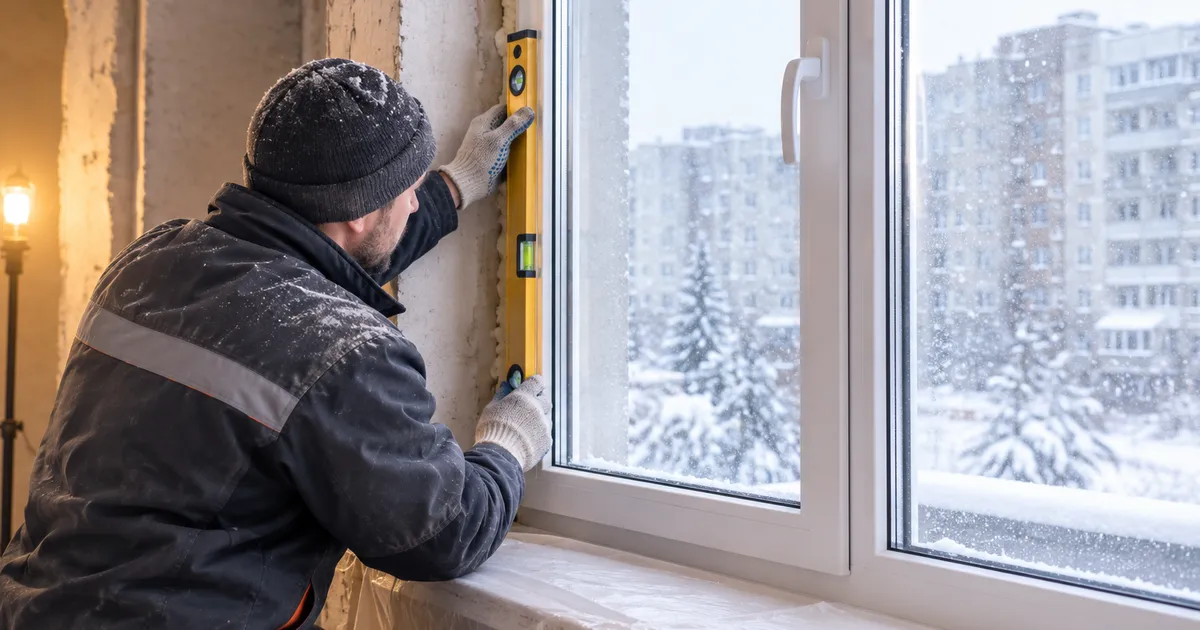
- Check the frame level after each fastening stage
Filling Gaps
- Use frost-resistant mounting foam
- Apply foam in thin layers (each no more than 2-3 cm)
- Ensure air access for polymerization
Insulating the Installation Seam
- Outer layer — vapor-permeable tape
- Inner layer — vapor-impermeable tape
- This prevents condensation in the insulation
UWS Expert Tip: Our installation crews have experience working in winter conditions. We use only frost-resistant materials and follow special technology for winter installation.
Materials for Winter Installation
Winter installation requires special materials adapted to low temperatures.
Mounting Foam
| Parameter | Regular Foam | Frost-Resistant Foam |
|---|---|---|
| Temperature Range | +5°C to +35°C | -10°C to +40°C |
| Polymerization | fast | slow |
| Cost | lower | higher |
| Application | summer | year-round |
Insulation
- Mineral wool — not afraid of frost, but requires waterproofing
- Polystyrene — frost-resistant, but brittle at low temperatures
- Foam tape (PSUL) — ready-made solution for insulating installation seams
Waterproofing Tapes
- Vapor-permeable (outer) — releases moisture outward
- Vapor-impermeable (inner) — does not allow moisture into the seam
Sealants
- Silicone sealants — work at temperatures down to -40°C
- Acrylic sealants — for indoor work, not frost-resistant
Important: Don’t save on materials for winter installation. Cheap mounting foam or lack of vapor barrier can lead to freezing of the installation seam and mold growth.
Advantages and Disadvantages
Advantages of Winter Installation
- Lower prices — seasonal discounts from manufacturers and installation companies
- Faster completion — fewer queues, work is done faster
- Easier to detect problems — drafts and cold bridges are immediately noticeable
- Comfort in the apartment — no need to live with open openings in the cold
Disadvantages of Winter Installation
- Higher material costs — frost-resistant foam is more expensive
- More difficult weather conditions — snow, wind, short daylight hours
- Temperature restrictions — in severe frost (-20°C and below), it’s better to postpone installation
When to Postpone Installation
- Air temperature below -15°C (for standard materials)
- Strong wind (over 10 m/s)
- Precipitation in the form of rain or wet snow
- High humidity (over 80%)
Tips for Winter Installation
If you decide to install windows in winter, follow these recommendations.
Preparation
- Check the weather — choose a dry day without precipitation
- Prepare the room — cover furniture with plastic to protect from dust
- Ensure heating — room temperature should be at least +15°C
During Installation
- Don’t rush — frost-resistant foam polymerizes more slowly
- Carefully check the frame fit tightness
- Use a heat gun to warm the opening if necessary
After Installation
- Don’t open windows for 24 hours (for complete foam polymerization)
- Check airtightness after the first night
- Fix all hardware adjustments
Contact UWS: We guarantee the quality of winter installation. Our experts use special materials and technologies adapted to the Ukrainian winter. Learn more at uws.com.ua. UWS performs window installation and window repair in Kyiv year-round, including winter.